Hazbin Hotel Season 2 Review
Updated 2025 Nov 16 by Likho (licho@firemail.cc)
Hazbin Hotel Season 2 is an American animated cartoon about the Princess of Hell and her hotel to rehabilitate sinners and send their souls to Heaven to alleviate overpopulation in Hell.
In Season 1, the series leaves off at the hotel successfully defending itself from an army of exorcist angels that antagonize the concept of post-mortem redemption. Season 2 is releasing two episodes per Wednesday of November, so I’m reviewing the episodes as I go.
You can read about Season 1 at another page. As an extra note, not even an Amazon-funded animation will draw 4 fingers on its characters.
Characters
These characters were present in Season 1, but in Season 2, they have more significance or their characterizations have been expanded on.
Katie Killjoy
Katie Killjoy is an anchorwoman under the employ of Voxtek Entertainment. She first appears in the pilot episode, making a mockery of Charlie’s unproven concept of redemption and highlighting Angel Dust’s behavior to the contradiction of Charlie’s claims about his betterment.
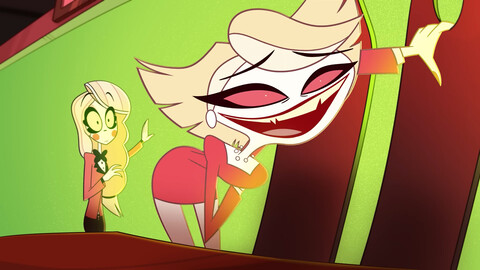
In Season 2, she serves a similar role in exploiting Charlie’s naivety and lack of media training.
There is a voice actor change for Katie Killjoy between the pilot and the Amazon series. I don’t know why because the voice actress was doing a good job; the character now has a nasally male voice.
Vox
Vox is the CEO of VoxTek Entertainment, a fictional amalgam of Silicon Valley and Hollywood in Hell. He is a blue-themed TV-headed demon with electrokinetic and mind control powers. He is introduced to have a rivalry with Alastor in Season 1 and is the primary antagonist of Season 2.

While he doesn’t directly confront Charlie or threaten violence, he poaches influence from the hotel and ruins her public image.
Alastor
Alastor was the hotel’s first patron. He was responsible for its repairs and renovations, despite not fully aligning with its cause. His attitude sours after Season 1.
Lute
Lute is an exorcist angel holding the rank of lieutenant that first appeared in Season 1. She, like Adam, follows Old Testament style morals, testifies against the concept of redemption, and vows vengeance over Hell’s self-defense against extermination.
She is also shown to have loved Adam, though has never admitted it to him. While I don’t see what she sees in a man that calls her “Dangertits”, it may have to do with the song Gravity if Adam’s rockstar career in Heaven produced anything like it.
Thanks to Amazon money, Hazbin Hotel is dubbed in multiple languages. The best performance of “Gravity” I’ve heard is the Turkish one where the male vocals are more distinct and the female vocalist performs a vibrato in the place where the lyrics “hard rain” would have been.
Gravity (Turkish), https://www.youtube.com/watch?v=QLiV-T95nvk
Gravity (English), https://www.youtube.com/watch?v=5eZonu8XsEs
Rosie
Rosie first appears at the end of Season 1 to help Charlie and Alastor defend the hotel.
Rosie is an overlord holding dominion over Cannibal Town, an exceptionally orderly and clean part of Hell.
Charlie Becomes a Lolcow
… and constantly repeats mistakes to the point it’s arguably poor writing.
The media did a hitpiece on me and my hotel.
I’ll go to the media to set things right.
— Charlie’s thought process for 6/8 episodes of Season 2.
It’s like the time a Reddit moderator went on Fox News,1 but the anchorman wasn’t as sadistic and the humiliation wasn’t as prolonged.
Charlie’s inability to present herself to the media spans multiple episodes in spite of a successful speech to a crowd in Cannibal Town in Season 1. In the first episode of Season 2, she loses her cool and stammers in front of a crowd of reporters. At the end of episode 1, Katie Killjoy creates a hitpiece on her hotel while portraying Vox as sympathetic to the needs of sinners.
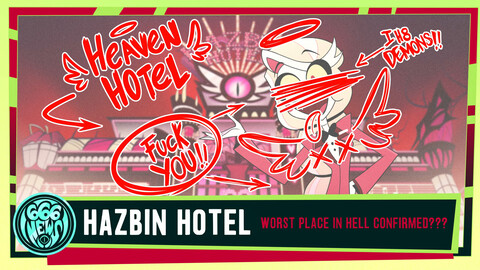
In Episode 3, the nature of the hitpiece flies over her head. She invites Vox, to report on a sucessful redemption despite having no audiovisual material to support her claims. She also falls for traps similar to “have you stopped beating your wife”?
When asked for proof beyond her own words, she hastily tries to redeem one of her residents (Angel Dust) on the spot despite not fully understanding the mechanism of redemption. She even stages a scenario for Angel to be a hero while putting Husk in danger. In failing to demonstrate redemption, Vox uses the material he recorded to create another hitpiece on Charlie’s hotel.
Her reaction?
She once again demands to use his platform, this time, a live television broadcast to clear up misconceptions, only to blunder again. She goes on Katie Killjoy’s show (again). Based on the pilot episode and the end of Season 2 Episode 1, she would know it isn’t a good idea.
Overall, she acts more deranged and impulsive compared to her season 1 and pilot characterization even when she no longer has a reason to be in emotional shock over the final death of a friend.
Alastor gets buck broken, also his human reveal
Alastor is revealed to be a human that had died in 1930s, formerly living in New Orleans, Louisiana. He is of the middle or upper class and was working towards a career as a radio host. However, he was also a serial killer that practiced magic.
While ages aren’t obvious with a cartoon artstyle, I assume he died at the age <24 for a few reasons.
- he sold his soul to be the most powerful sinner in Hell, which carries some youthful edge
- he is referred to as a “twink” and “brat” by Vox.
I had preferred Alastor when he was mysterious. Even obfuscating Alastor’s lines about becoming the most powerful sinner in Hell with Rosie’s paraphrasing would’ve been enough.
This reveal was still entertaining now that the “buck breaking” meme applies well to Alastor for the events in Episode 4.
The Vees vs Alastor’s fight sequence
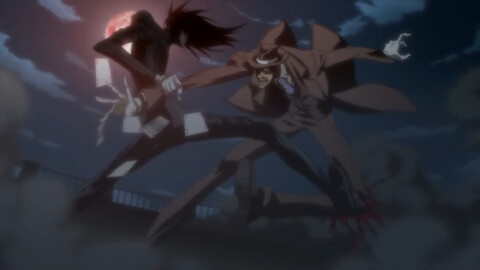
I saw the cards flying in this episode, and this jogged a memory of Alucard vs Toublecain Alhambra.
By this season, I realized Alastor resembles Alucard from Hellsing. The two have shadow powers and are the effective trump card of the cast. But between Alucard and Alastor, Alastor is overall a worse fighter for the lack of practical use of his more versatile powers. (Alucard doesn’t summon extra appendages; unless unrestricted, his shadows are instead undead familiars.)
Against angels and blessed armaments, Alastor doesn’t have time to squander. However, Alastor consistently grabs and slams opponents with his shadow tentacles, lacking practical goals in the fight. Whereas Alucard aims to disable or incapacitate opponents.

Even if Alastor’s plan was intentional surrender, at least knocking Velvette out of the fight when he had the chance, would give better leverage in his deal with Vox and put Husk and Niffty in less danger.

Alastor has much supernatural power. But he mostly picks on powerless demons throughout Season 1. In fairer fights against (arch)angels or overlords, Alastor lacks tactics, making his fight uninteresting to watch.
Vox and Alastor’s Backstory
In Vox and Alastor’s flashback, Vox is portrayed to be a newer and naive demon who wanted to partner with Alastor but was harshly struck down. With Vox’s corporate character, the case could have been Alastor refusing an exploitative contract, but it’s revealed that Alastor was just mean.
For this scene alone, I didn’t think there was any personality flaw in Vox wanting to make allies and friends in his cursed afterlife. The primary schism between Alastor and Vox are in what they fundamentally are.
Vox is a TV-headed demon and is more of a personification of a television while Alastor is a radio host. Meaning, Vox relies on others to produce content for him and his corporation to broadcast. Alastor produces his own content, using radio as a medium as opposed to being a personification of a radio.

Alastor’s reasons are more justified when examples of Vox’s content include brainrot such as Yeah I Fucked Your Sister, So What?, catering to the broadest audience for maximum commercialization. It can be inferred that Alastor pursues a niche reflective of his own personal tastes even if is dated or isn’t trendy.
Lucifer’s Limitation and My Guess at Alastor’s Deal
The premise of the series is that Heaven has been exterminating sinners in Hell because of overpopulation for 7 years. This coincides with Alastor’s and Lilith’s disappearances.
As of Episode 5, it is revealed that Lucifer has some limitations with his interactions with sinners. While I won’t detail it here, it gives me a suspicion of why Alastor disappeared:
- Alastor was the population control method before Heaven came
up with exterminations.
- he is no longer needed until Charlie set up her hotel.
- He is either an indirect agent of
- the Morningstars (or specificaly Lilith)
- Heaven
- a not yet revealed entity that would also have a reason to suppress Hell’s population.
This raises questions as to who or what Rosie is.
According to Season 1, Alastor was already a powerful demon when he first arrived to Hell as a new sinner. His initial targets were other demon overlords.
Season 2’s scenario of Vox accumulating power and influence is unfavorable for both Hell’s monarchy and Heaven for reasons depicted in Episode 5 by the songs Vox Populi and Vox Dei.
So who is really pulling Alastor’s string and why?
Point (2) is supported by the fact Alastor is not made to be more powerful than an archangel, but this is contradicted by Adam’s antagonism in Season 1.
Point (1) is supported by Rosie quickly supporting Charlie, for both the internal and external conflict in the season finale, despite their last minute acquaintance in Season 1. Additionally, Rosie obligates Alastor to continue his support of Charlie’s hotel.
Either way, Alastor knows his job is to control the overlords of Hell. Intentionally boosting Vox’s influence disrupts the status quo in Hell.
I think he is going to be an antagonist in a future season.
Vaggie is as dumb as Charlie
The entire season thus far has consisted of the protagonists repeating the same mistake to the point it’s hard to watch.
By episode 3, it’s clear enough that Charlie shouldn’t be using Vox’s platforms. Vaggie even tried to reason with Charlie about this. However, in episode 5, both Charlie and Vaggie try to engage Vox and fail spectacularly.
When the angels visited Charlie’s hotel, easily what she should have done was direct them to the hotel’s guests both to prove redemption is possible and improve guest retention. The very bad idea was directing them to Vox’s fanbase and going to a live event where she doesn’t have the mic to speak over the angry crowd.
When you’re waiting one week for the next bundle in the chain of events, it’s a letdown to see the protagonists more or less retread the same ground.
So far, most of the effort in Season 2’s writing went to Vox’s character. If you don’t like the character, the series is easily droppable once you get tired of Charlie.
To be continued for future episodes.
Reddit r/antiwork Moderator on Fox News, https://www.youtube.com/watch?v=wmNAsbwuBnY↩︎